Blog
What Are the 8 Love Types? A Complete Guide
July 29, 2026
“I love you” is one sentence doing the work of at least eight. The love you feel for a best friend, a new crush, a partner of twenty years, and your own reflection on a good day are not the same emotion wearing different outfits — they’re different types of love, and people have been sorting them into categories for about 2,500 years.
This guide walks through the classic 8 types of love from Greek thought, what modern psychology kept and threw away, and how those old categories map onto the eight Love Type archetypes we use across this site.

Key Takeaways
- The ancient Greeks named eight distinct types of love — eros, philia, storge, agape, ludus, pragma, philautia, and mania — and psychologists later turned several into measurable “love styles” (Colour wheel theory of love, Lee, 1973).
- In 2019, 90% of married US adults said love was a major reason they got married, far ahead of finances at 13% (Pew Research Center, 2019).
- The 8 Love Types are modern archetypes — like the Slow Burner and the Grand Gesturer — that describe how you love, not just whom.
Where Does the Idea of “Types of Love” Come From?
The vocabulary is ancient, but the science is surprisingly recent. In 1973, Canadian sociologist John Alan Lee published Colours of Love, borrowing Greek terms to define six love styles arranged like a colour wheel: three primary (eros, ludus, storge) and three secondary (mania, pragma, agape) (Colour wheel theory of love, 1973).
Lee’s wheel might have stayed a curiosity, except that in 1986 psychologists Susan and Clyde Hendrick built the Love Attitudes Scale on top of it — a questionnaire that let researchers actually measure which styles a person leans on. That same year, Robert Sternberg proposed his triangular theory: every experience of love mixes three ingredients — intimacy, passion, and commitment — and the mix determines the type.
Here’s the neat part. Sternberg’s three ingredients can each be present or absent, which yields exactly eight combinations, from nonlove (none of the three) to consummate love (all three). So whether you start from the Greek lexicon or from a psychology lab, you keep landing on the same answer: love isn’t one thing. It’s a small family of things.
What Are the 8 Greek Types of Love?
The Greek list is the one you’ll see most often, and it’s the best starting point because each word isolates one recognizable feeling. Popular guides like The Knot’s overview of the types of love cover similar ground; here’s the short version, with the modern read on each.
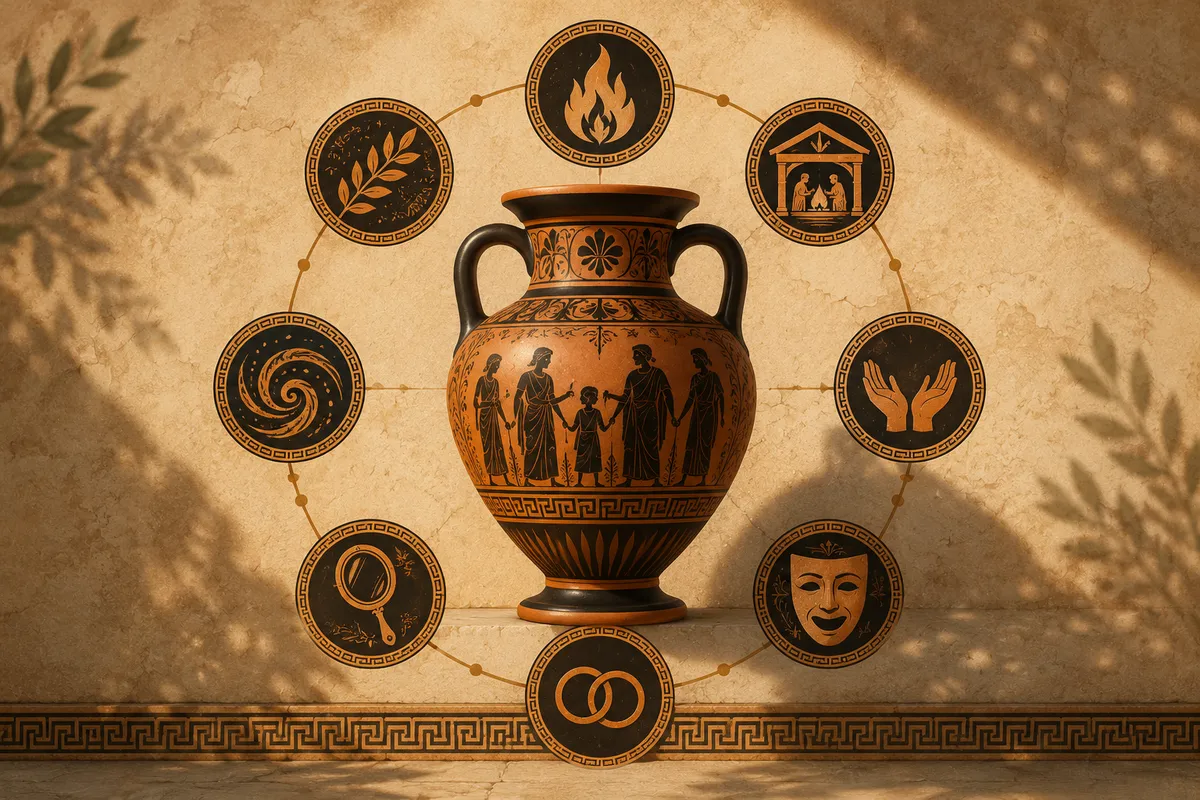
1. Eros — passionate love
Named for the god of desire. Eros is the fiery, all-consuming attraction of a new romance: racing pulse, idealized partner, can’t-look-away intensity. It burns hot and, left alone, burns out — which is why every lasting relationship eventually has to convert eros into something sturdier.
2. Philia — deep friendship
The love between equals who choose each other. Aristotle rated philia above eros, because it’s rooted in shared values and goodwill rather than desire. In romantic relationships, philia is the “we’re genuinely friends” layer that predicts whether you’ll still like each other on a boring Tuesday.
3. Storge — familiar affection
The love that grows out of familiarity, most obviously between parents and children. It doesn’t announce itself; it accumulates. In couples, storge shows up as the comfortable, worn-in affection of people who share a home, a routine, and a decade of inside references.
4. Agape — selfless love
Unconditional goodwill toward another person — love that expects nothing back. Religious traditions claimed the word, but you don’t need theology to recognize it: it’s caring for someone at cost to yourself, quietly, because that’s simply what you do.
5. Ludus — playful love
Flirtation, teasing, the fizzy euphoria of early dating. Ludus treats love partly as a game, and that’s not automatically shallow — couples who keep a ludic streak keep laughing together. It only turns sour when the game matters more than the person.
6. Pragma — enduring, practical love
Love as a long-term project. Pragma is what you see in couples who have made it decades: standing commitments, negotiated compromises, effort renewed on ordinary days. Where eros falls in love, pragma stands in love.
7. Philautia — self-love
The Greeks distinguished healthy self-regard from vanity. Healthy philautia — knowing your worth, tending your own needs — is the platform every other type stands on. You can’t pour from an empty amphora.
8. Mania — obsessive love
The imbalance case: jealousy, possessiveness, self-worth outsourced to another person’s attention. Lee modeled mania as eros plus ludus with the brakes cut. It’s on the list not as a goal but as a warning label.
Why Do the Types of Love Matter?
Because love is the thing people actually build their lives around, and the type determines what “love” demands of you. As of 2019, 90% of married adults in the US said love was a major reason they decided to marry — ahead of companionship at 66%, formal commitment at 63%, and far ahead of finances at 13% (Pew Research Center, “Why people get married or move in with a partner”, 2019).
The science backs the multi-part model, and not just in Western samples. In 2023, a team including Sternberg himself validated the short Triangular Love Scale (TLS-15) with 60,311 participants across 156 countries, finding the same intimacy–passion–commitment structure across 37 languages (Kowal et al., Archives of Sexual Behavior, 2023). An earlier study of 7,332 people in 25 countries reached the same conclusion (Sorokowski et al., The Journal of Sex Research, 2021). Love’s ingredients look remarkably universal; what varies is the recipe each person cooks with.
And that’s the practical question the Greek list can’t answer on its own: knowing that pragma exists doesn’t tell you that your partner is a pragma-first lover who hears “I love you” in a renewed car registration. For that, you need types that describe people, not just feelings.
What Are the 8 Love Types? The Modern Archetypes
The 8 Love Types are personality archetypes: they describe how a person gives love, receives it, builds trust, and behaves when it counts. Each one leads with a different answer to “how do I know you love me?”
- The Slow Burner — cautious and deep. Trust is earned through consistency, and loyalty is the love language. Doesn’t fall fast; falls permanently.
- The Grand Gesturer — loves big, public, and cinematic. Feels most loved when celebrated at full volume.
- The Practical Heart — love equals usefulness. Filled the car, fixed the shelf, handled the errand you were dreading. That’s the poem.
- The Chaos Romantic — spontaneous and playful. Surprise, humor, and shared silliness are how connection stays alive.
- The Fortress — guarded outside, sentimental inside. Values private meaning that outsiders never see.
- The Cozy Nester — home is the love language. Rituals, comfort, and shared space say what words don’t.
- The Wordsmith — expresses love in writing, inside jokes, and personalization. Keeps the screenshots.
- The Adventure Partner — experiences over objects. Love sounds like “look what I found for our next trip.”
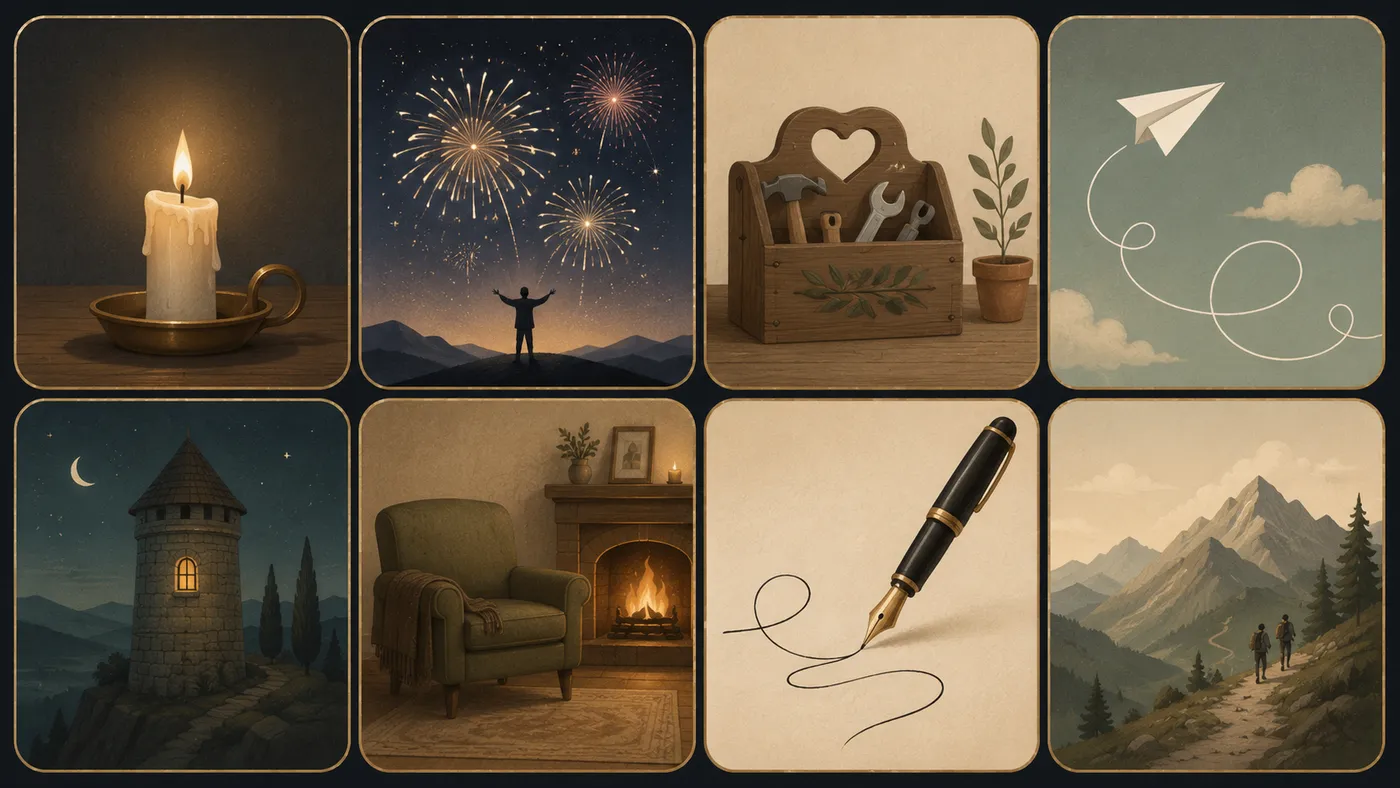
Each archetype page covers the type’s core traits, red flags, ideal dates, and even texting style, so they’re worth a read for your own type and your partner’s.
How Do the Greek Types Map to the 8 Love Types?
Loosely but usefully. The Greek words describe feelings; the archetypes describe people — so one Greek type can flow through several personalities, and two of them aren’t person-types at all.
| Greek type | Nearest Love Type cousin |
|---|---|
| Eros (passion) | The Grand Gesturer |
| Ludus (play) | The Chaos Romantic |
| Storge (familiar comfort) | The Cozy Nester |
| Pragma (enduring effort) | The Slow Burner, The Practical Heart |
| Philia (chosen companionship) | The Adventure Partner, The Wordsmith |
| Agape (quiet devotion) | The Fortress |
| Philautia (self-love) | The foundation under all eight |
| Mania (obsession) | None — it’s the warning label, not a type |
Notice what the mapping quietly teaches. If you’re a Grand Gesturer with a Practical Heart partner, neither of you is “bad at love” — you’re fluent in eros while they’re fluent in pragma. Different dialects, same language. Most relationship friction over “you never show you care” is really a translation problem between two valid types of love.
How Do You Find Out Your Love Type?
Start with evidence, not introspection. What did you do the last three times you wanted someone to feel loved? What gesture from a partner actually landed, versus the one you politely thanked them for? Your instinctive answers cluster around one or two archetypes far more reliably than your idealized self-image does.
Then pressure-test it. The types show up most clearly at the edges: how you argue, how you apologize, what you do with an ordinary Wednesday. A Slow Burner apologizes with changed behavior; a Wordsmith with a paragraph; a Practical Heart by wordlessly fixing the thing you fought about.
Or skip ahead: the 2-minute Love Type quiz asks about exactly these behaviors and hands you your archetype at the end. If you’re already sure of your type and your partner’s, the compatibility guide breaks down how each pairing tends to click and clash, and our post on talking about love languages without keeping score pairs well with either.
Frequently Asked Questions
What are the 8 types of love?
The eight types of love from ancient Greek thought are eros (passionate love), philia (deep friendship), storge (familiar affection), agape (selfless love), ludus (playful love), pragma (enduring love), philautia (self-love), and mania (obsessive love). Modern research, like Lee's 1973 colour wheel of love, formalized several of these into measurable love styles.
What's the difference between love types and love languages?
Love languages describe how you prefer to give and receive affection day to day. Love types describe the deeper pattern behind those preferences: how you build trust, what makes you feel secure, and how you show commitment. The two overlap, but a love type is closer to a personality profile than a communication preference.
Is there scientific evidence for different types of love?
Yes. Sternberg's triangular theory holds that love combines intimacy, passion, and commitment, and a 2023 validation of its short scale (TLS-15) with 60,311 participants across 156 countries found the same three-part structure across 37 languages (Kowal et al., Archives of Sexual Behavior, 2023).
How do I find out my love type?
Watch your own behavior: what you do when you want to show someone you care, and what lands when someone cares for you. Consistency points to the Slow Burner, novelty to the Chaos Romantic, usefulness to the Practical Heart, and so on. A structured quiz shortcuts the guesswork by asking about those behaviors directly.
The Bottom Line
“Types of love” isn’t one list — it’s three that agree with each other. The Greeks named eight feelings, from eros to mania. Sternberg’s triangle mixes intimacy, passion, and commitment into eight combinations, a structure that held up across 156 countries and 60,000+ people. And the 8 Love Types turn all of that into something you can act on: a profile of how you and your partner actually give and receive love.
The payoff isn’t trivia. Once you can name your type — and, more importantly, your partner’s — half the “you don’t care” arguments dissolve into translation errors you can actually fix. Find your archetype with the Love Type quiz, then go read what your partner’s type has been trying to tell you all along.
Related
Curious what this means for your relationship? Take the 2-minute Love Type quiz or browse gift guides by personality type.